
Hiking in Spain is not like hiking in the United States
By Jason Milligan
I pressed down on the barbed wire and slowly lifted a leg over the now taut fence. Cautiously, I shifted my weight, passed my second leg over the barbs, and gently lowered my body down onto my backpack. In theory, I would no longer be traipsing across an overgrown and unmaintained trail on private property. Ahead of me was a rural public road that snaked up into the mountains leading to my next destination, a via ferrata. Relieved to no longer be bushwhacking, I hiked up the path and almost immediately encountered wild Iberian hogs — an agitated, acorn-eating family with a likely future as cured ham.
Coyotes, rattlesnakes, bears — these were animals I was accustomed to dealing with. Navigating around wild pigs was new to me. One thing had become clear: long-distance hiking in Spain was not like in the United States.
In the summer of 2024, my wife and I arrived in Málaga with several pieces of luggage and an open-ended experiment in mind. We had decided to leave Los Angeles and try living in Spain for an undetermined amount of time.
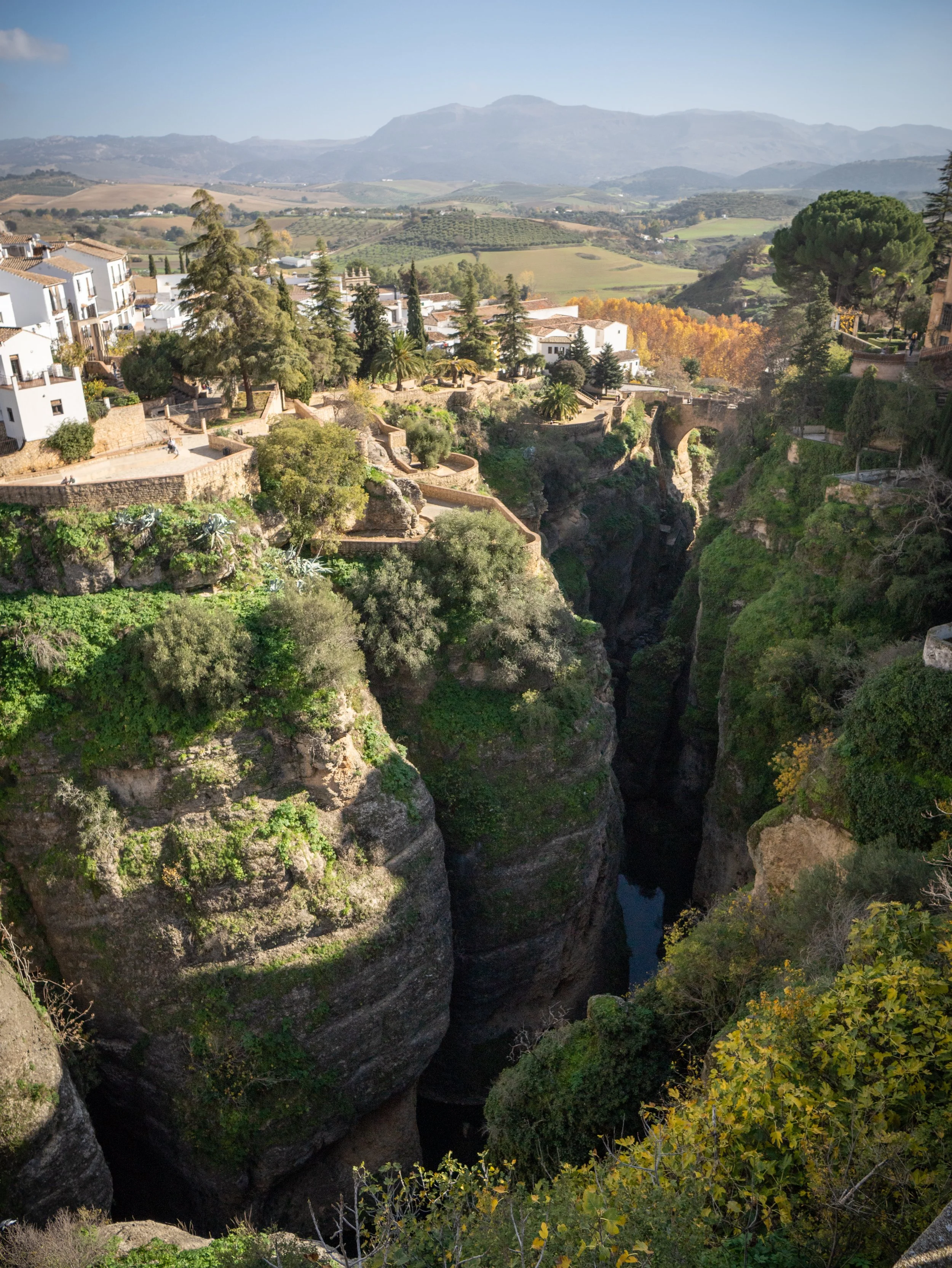
I was an active outdoors person — climbing, canyoneering, backpacking — and Spain is an easy place to maintain that lifestyle. We explored trails near our apartment over the first few months, but I was eager for something longer and more involved. And so, instead of simply hiking one of the pre-established routes in the region (like a sensible person would do), I pieced together my own — an amalgamation of various trails that would take me south from Ronda through the mountains to Estepona on the coast, passing through multiple small mountain towns and up to 16 via ferrata routes along the way. A weather window opened in early December, and I hopped a bus to Ronda.
A view in Ronda, my starting point
What I hadn't fully accounted for was how differently Europe relates to land.
Humans have inhabited this continent for many thousands of years — centuries more than the Americas — and that history is written into the landscape in ways that are impossible to ignore. Ancient structures. Remnants of industry. And eons of infrastructure built long before the concept of public lands and national parks was ever imagined. Spain has embraced conservation — nearly a third of the country is protected — but the preponderance is private farmland and pasture, and hiking here means frequent encounters with livestock and trails that meander alongside, and often through, property that belongs to someone else.
Living in the Western US for two decades, I had grown accustomed to enormous swaths of uncultivated wilderness where you could disappear from civilization for days. In 2019, I spent 26 days on the John Muir Trail in the Sierra Nevada and encountered very little of the human world; I would have had to walk multiple days off-trail to find any. US public lands also tend to allow wild camping — as long as you follow certain rules, you can often pitch wherever you like, for free or close to it.
Spain has taken a different approach. Wild camping is typically illegal. The expectation is that you'll overnight in a hut, a rented room, a free mountain refugio, or a designated campground. This makes spontaneity and frugality considerably trickier — and it complicated my 60-mile, four-day hike through the mountains of Málaga in ways I hadn't anticipated. Along my path, there were no refugios, huts, or campgrounds. The solution: one night in a paid hostel, one night under a tarp in the mountains, and another hidden on a hillside on the outskirts of town after I failed to find any available rooms. The entire town, it turned out, was closed for a day of rest.
Technically, two of those three nights broke the rules. But something else I've learned about Spain is that, though it is a land of many rules, most of them are ignored.
So, yes, hiking long distances for days through the wilderness relying solely on the contents of your backpack is less common and less accessible in Spain. But that does not mean what it has to offer is less rewarding. To the contrary, it is a worthwhile experience of its own. Trails are often well-maintained and signed, and the via ferrata routes are commonly built on the edge of, and sometimes through, town, accessible diversions that put dramatic views within reach of anyone willing to clip in.
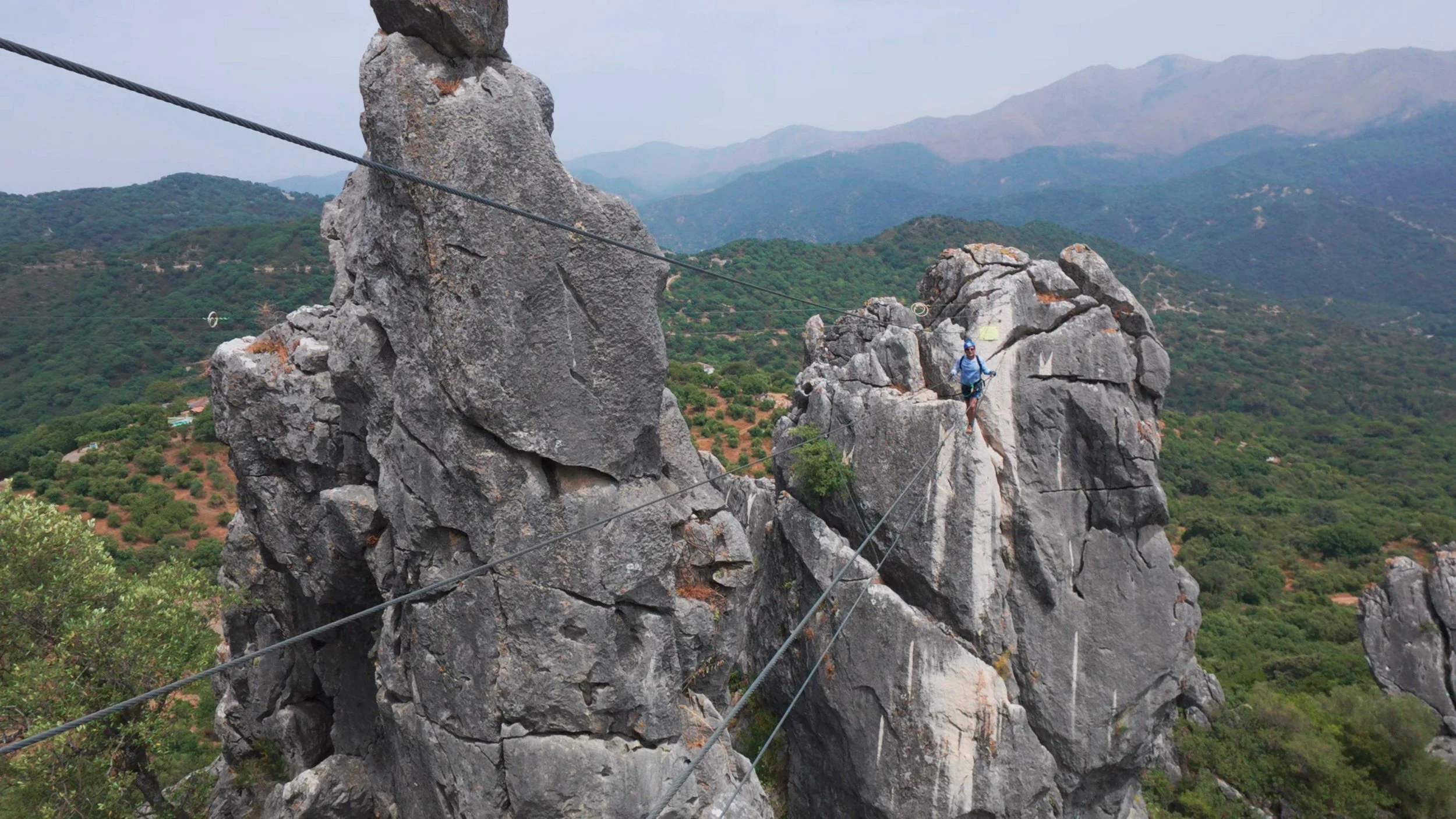
My favorite Via Ferrata of my Spain hike, Castillo de Aguila, one of its cable bridges
Hiking through Spain gives you a broader picture of humanity's place in the environment. You pass through small towns built into the natural landscape where agriculture is still experienced on a local level. You encounter varied customs, ancient structures, regional cuisines, and rural lifestyles unlike anything back home. Backpacking here is a wilderness experience braided together with a travel experience, with the unmistakable sense that people have been moving through this landscape for a very long time before you arrived.
The wild pigs, it turned out, responded to the same logic as most animals: repeated blasts of a whistle and a refusal to back down. Some were more stubborn than others, but I avoided any maulings. There was still another day of hiking ahead — more backtracking around fenced trails, an all-night walk searching for shelter and finding only more private property, and eventually my favorite via ferrata of the trip, a course built alongside the castle ruins of Casares.
When I got home, I had experienced an adventure genuinely different from anything back in California. Fulfilling and rewarding, just by a different measure.
Watch Jason's journey through the mountains of Málaga: